Capstone Project: Coupled LC Oscillator Based Ising Machine
Abstract
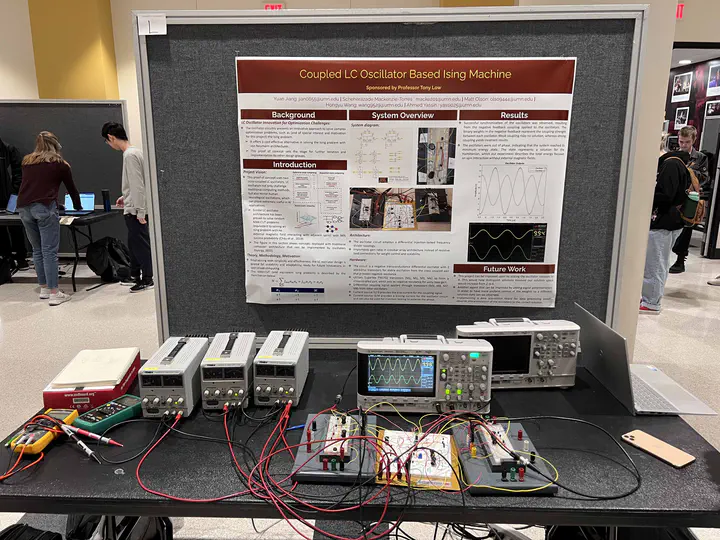
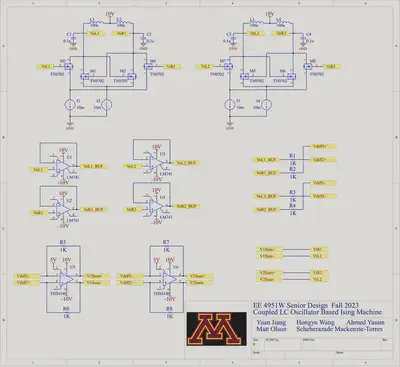
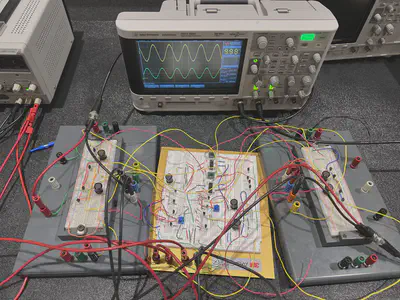
In the realm of computational architectures, a pressing challenge has been the efficient solution to complex optimization problems, such as MAX-CUT problems and general Ising models. Today, this issue finds itself at the forefront with the new advances in artificial intelligence (AI) and quantum computing. Traditional von Neumann architectures, while versatile, face limitations handling such tasks due to their sequential processing nature and scalability constraints. This project was initiated to address these limitations by exploring an alternative approach using LC oscillators. The LC Oscillator Ising Machine represents a novel venture into harnessing the potential of simple circuit components to tackle problems traditionally deemed challenging for conventional computing methods. Our objective was to design and implement a system that utilizes the unique properties of LC oscillators, specifically their oscillatory nature and phase relationships, to solve the Ising problem and offer a cost-effective alternative in computational architectures.

Yuan Jiang
ASIC Design & DV
I’m currently actively seeking new graduate full-time opportunities in ASIC Design Verification and RTL Design, and I’d be excited to explore roles that align with my background.